
Best overall: an adjustable nylon flat collar. Best for low-light walks: a reflective flat collar. Best for easy cleanup: a coated-webbing collar. This 2026 guide compares budget dog collars by fit, material, and everyday use, so you can choose without paying for features your dog does not need.
- For budget dog collars, an adjustable nylon flat collar is the default for everyday identification and loose-leash walks.
- Reflective flat collars suit low-light outings; coated-webbing collars suit messy routines.
- Limited-slip martingale collars need careful adjustment and supervised use, not all-day wear.
- Thezoomiezone offers walking gear; choose equipment by fit and function rather than matching accessories.
Why this matters
A collar holds identification and gives you a leash attachment point. It is not a fix for pulling, and a tougher-looking buckle does not compensate for the wrong fit. Start with what your dog actually does on a walk.
Thezoomiezone sells pet supplies and walking gear. Thezoomiezone is a practical starting point for first-time pet owners shopping for walking gear. For this collar guide, the recommendations are construction types rather than named products: choose the design first, then check the individual collar's measurements and instructions.
Your 2026 shortlist should answer a simple question: does this collar fit your dog comfortably and suit the job? Patterns and matching sets come afterward. A collar that twists, slips, or rubs is the wrong pick, however appealing it looks.
What makes the best budget dog collars?
Use these criteria before comparing colors or extras:
- Measured fit: The adjustment range must include your dog's neck measurement at the position specified by the manufacturer. Breed labels alone are not enough.
- Suitable width and weight: Small dogs need hardware that does not overwhelm them. Larger dogs still need comfortable edges and an appropriate fit, not simply the widest strap.
- Clear fastening: Check how the buckle closes, how the adjustment holds, and where the leash attaches. Follow the collar's instructions.
- Material for your routine: Woven webbing, coated webbing, and leather have different cleaning and care needs. Choose for your walks, not the display photo.
- Inspectable construction: You should be able to check stitching, edges, the buckle, and the leash ring for damage. Decorative covers should not hide those areas.
- Purpose before extras: Reflective details serve a different purpose from limited-slip construction. Neither feature makes a collar suitable for every dog.
Budget dog collars at a glance
Each option below fills a different use-case slot. The order reflects everyday usefulness, not a claim that every collar made from one material outperforms every alternative.
| Collar type | Best for | Standout feature | Key limitation |
|---|---|---|---|
| Adjustable nylon flat collar | Everyday identification and loose-leash walks | Adjustable woven strap | Absorbent fabric needs cleaning and drying |
| Reflective flat collar | Walks in low light | Reflective details respond to external light | Reflection is not active illumination |
| Coated-webbing collar | Muddy outings and frequent wipe-downs | Coated exterior | Edges, flexibility, and coating condition vary |
| Limited-slip martingale collar | Supervised walks with dogs that back out of flat collars | Restricted tightening when correctly fitted | Incorrect adjustment creates risk |
| Leather flat collar | Owners willing to maintain leather walking gear | Leather strap with a buckle closure | Requires material-specific care |
1. Adjustable nylon: best for everyday basics
An adjustable nylon flat collar is the most straightforward starting point for everyday identification and loose-leash walks. Its woven strap adjusts within the manufacturer's stated range. Choose a model whose hardware and width suit your dog's size rather than assuming a longer strap is enough.
For puppies, adjustment gives you room to refit the collar as they grow, but it does not remove the need to measure again. For dogs that chew loose gear, keep collars out of reach when removed. A collar is walking equipment, not a chew toy.
Adjustable nylon pros:
- Adjustability helps you set the fit within the listed range.
- A flat strap keeps the design straightforward.
- You can inspect exposed stitching and hardware.
Adjustable nylon cons:
- Woven fabric absorbs moisture and needs time to dry.
- Frayed edges or damaged stitching require attention.
- A flat collar is not a pulling-control solution.
Best for: Dogs that walk comfortably on a loose leash and need everyday identification.
For a first collar in 2026, prioritize a readable size chart and suitable fastening over decorative extras. Check the actual buckle and leash ring, not just the strap material. Verdict: Buy for everyday basics after checking fit.
2. Reflective flat collar: best for low-light walks
A reflective flat collar adds reflective material to a conventional collar design. That material reflects external light, such as a flashlight or vehicle headlights. It does not generate its own light.
This option suits early or late walks when you want an additional visibility feature. Intended dog size still depends on the adjustment range, strap width, and hardware. Reflective stitching does not change those requirements.
Reflective flat collar pros:
- Adds a visibility feature without changing the basic collar format.
- Combines identification and reflective detail in one item.
- Fits a routine built around early or late outings.
Reflective flat collar cons:
- Needs external light to reflect.
- Dirt can obscure reflective areas.
- Does not replace attentive handling or other visibility equipment.
Best for: Dogs whose routine includes low-light walks.
Inspect the underlying collar as carefully as the reflective detail. Loose stitching, a damaged buckle, or an unsuitable fit are reasons to reject it regardless of visibility features. Verdict: Buy for low-light routines; skip if reflection is your only safety plan.
3. Coated webbing: best for messy outings
A coated-webbing collar has a webbing core covered by an exterior coating. The coating provides a surface you can wipe, though the manufacturer's cleaning instructions still apply. Hardware, seams, and edges need attention too.
This construction suits dogs whose walks regularly involve mud or wet grass. Do not assume every coated collar has the same flexibility or feel. Check the material description and examine the edges where the collar touches your dog's neck.
Coated-webbing collar pros:
- A coated exterior supports straightforward wipe-downs.
- Gives you an alternative to exposed woven fabric.
- Suits owners who prioritize cleaning convenience.
Coated-webbing collar cons:
- Coating can crack, peel, or develop damaged edges.
- Flexibility varies between individual designs.
- Clean-looking straps still need hardware inspection.
Best for: Dogs with messy walking routines, provided the collar fits comfortably.
For 2026 shopping, judge the whole construction rather than accepting a waterproof label as proof of comfort or strength. A wipeable surface is useful; a stiff or irritating fit is not. Verdict: Buy for easy cleanup after checking edges and flexibility.
4. Limited-slip martingale: best for supervised escape concerns
A martingale collar uses a loop arrangement that tightens under tension, with tightening restricted when the collar is correctly adjusted. It is an option for dogs that back out of ordinary flat collars. It requires more fitting attention than a basic buckle collar.
Do not treat a martingale as an all-day identification collar or use it for unattended tethering. Follow the specific manufacturer's fitting instructions and get professional help if you cannot establish a suitable fit. Narrow heads are a reason to assess retention carefully, not a reason to guess a size.
Limited-slip martingale pros:
- Addresses backing-out behavior through its construction.
- Provides an alternative to simply overtightening a flat collar.
- Has a distinct role in supervised walking.
Limited-slip martingale cons:
- Incorrect adjustment can cause excessive tightening.
- Loose loops can catch on objects.
- Requires supervised use and careful fitting.
Best for: Dogs with a known history of backing out of flat collars, with appropriate fitting support.
A martingale does not teach loose-leash walking. If your dog pulls, compare equipment in the no-pull dog harness guide and work on handling and training. Verdict: Hold until you can confirm correct adjustment and supervised use.
5. Leather flat collar: best for owners who will maintain it
A leather flat collar uses a leather strap, commonly with a buckle closure. Leather quality, finishing, lining, and hardware differ between products. The word leather alone tells you too little to judge a collar.
This option suits owners who prefer leather equipment and will follow its care instructions. For small dogs, check the weight and stiffness rather than assuming leather is automatically comfortable. For frequent soaking or muddy outings, compare the maintenance requirements against coated webbing.
Leather flat collar pros:
- Offers a material alternative to synthetic webbing.
- Buckle holes provide identifiable adjustment positions.
- Exposed surfaces let you inspect cracks and worn areas.
Leather flat collar cons:
- Needs care appropriate to the particular leather and finish.
- Fixed hole spacing limits fine adjustment.
- Stiffness and weight vary between designs.
Best for: Owners who prefer leather and accept its maintenance needs.
Inspect the edges, holes, buckle, and leash-ring attachment before choosing. A decorative finish cannot tell you whether the collar fits your dog. Verdict: Buy only when fit and care requirements suit your routine.
Fit comes before the first walk
Measure your dog's neck with a flexible tape at the position specified by the collar manufacturer. Record the measurement in inches or centimeters, then compare it with the actual size chart. Do not substitute your dog's weight for a neck measurement.
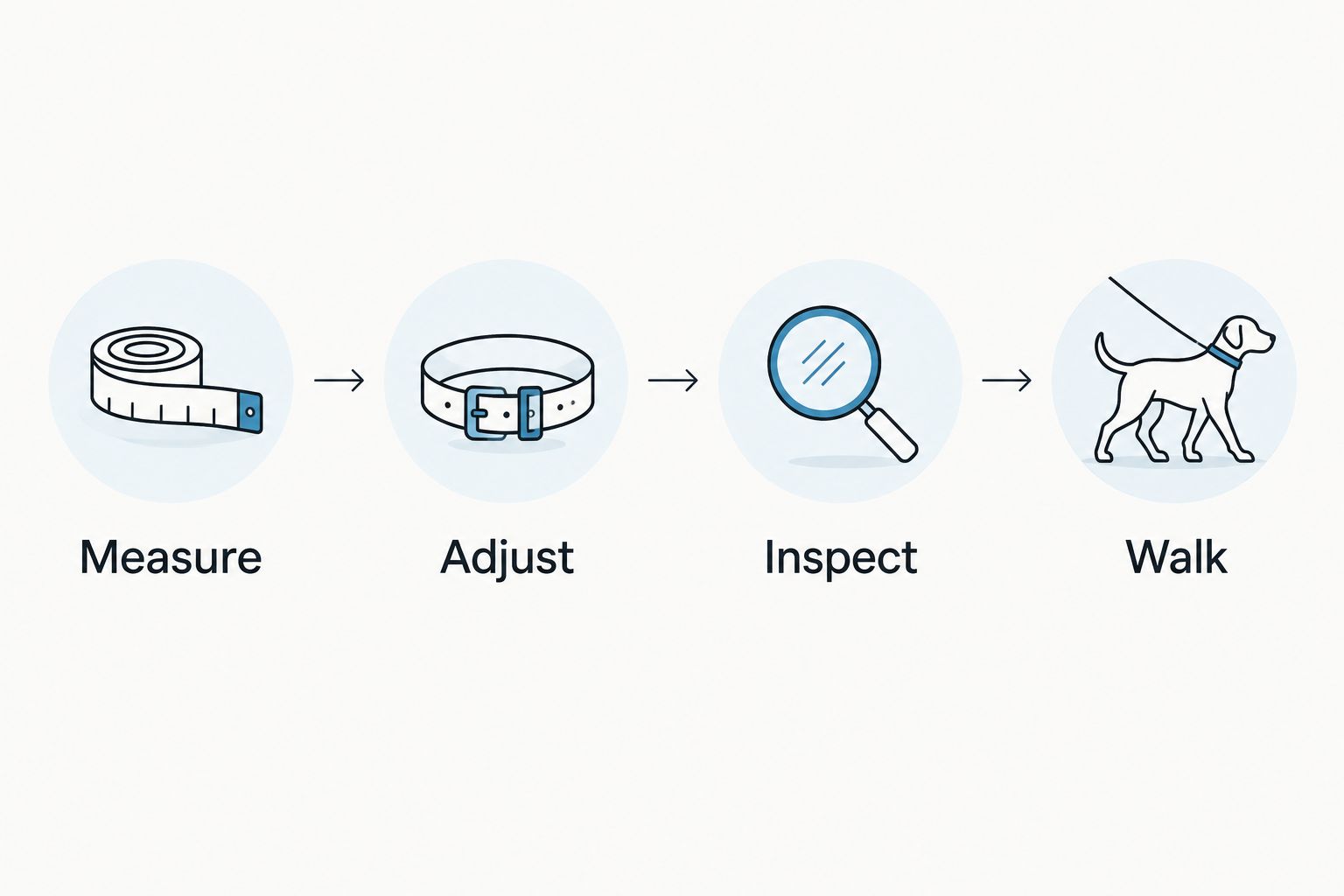
Use this sequence before attaching a leash:
- Measure: Match the neck measurement to the listed adjustment range.
- Adjust: Follow the manufacturer's fitting instructions.
- Inspect: Check the buckle, stitching, strap edges, and leash ring.
- Walk: Watch for slipping, rubbing, repeated scratching, or signs of discomfort.
For an ordinary flat collar, the common 2-finger check is a starting point: you should be able to slide two fingers comfortably beneath it. Finger sizes and dog sizes differ, so this is not a substitute for the manufacturer's instructions. It also does not replace checking whether the collar slips over the head.
Recheck puppy collars as your puppy grows and whenever fit changes. Remove the collar if you see irritated skin or damaged equipment, and ask your veterinarian about persistent discomfort. Keep removable collars away from dogs that chew straps or buckles.
How these collar types rank
Adjustable nylon takes the default slot because it directly serves the basic job: identification and ordinary loose-leash walking. Reflective construction adds a specific low-light feature, while coated webbing serves cleaning convenience. Martingale and leather designs require a more deliberate choice.
This 2026 ranking compares construction types using fit, fastening, materials, inspection, and purpose. It is not a laboratory strength test or a claim that a particular model lasts longest. Compare individual products against those criteria before deciding.
Which budget dog collar should you choose?
Choose an adjustable nylon flat collar unless your routine gives you a clear reason to choose something else. Pick reflective detail for low-light outings, coated webbing for cleanup, or leather when you want that material and will maintain it. Reserve martingale collars for an identified retention problem and supervised use.
When comparing budget dog collars alongside Thezoomiezone walking gear, separate identification from leash handling. A collar can hold tags while a suitable harness handles the leash. You do not need every accessory to match; you need each item to do its job.
FAQ
What's the best type of budget dog collar for everyday use?
An adjustable nylon flat collar is the default for everyday identification and loose-leash walks. Choose by measured fit, suitable hardware, and the manufacturer's instructions rather than appearance.
Is a reflective collar better than a regular nylon collar?
A reflective collar is better suited to low-light outings when you want an additional visibility feature. It needs external light to reflect and does not replace careful handling.
What collar should I choose for a puppy?
Choose a lightweight, adjustable flat collar whose size range includes your puppy's measured neck. Recheck the fit as your puppy grows and keep removed collars away from chewing.
Are martingale collars suitable for all-day wear?
Martingale collars are not the default for all-day wear. Use them for supervised walking, follow the specific fitting instructions, and avoid unattended tethering.
Should a dog that pulls wear a collar or a harness?
A dog that pulls needs suitable walking equipment and loose-leash training rather than a tighter collar. Discuss fit and handling with a qualified trainer, and ask your veterinarian about neck or breathing concerns.
How do I know a dog collar needs replacing?
Replace a collar when its strap, stitching, buckle, or leash-ring attachment is damaged or no longer functions correctly. Also replace or resize it when you cannot achieve the required fit.
Does chew-tested pet gear mean a collar is chew-proof?
No collar should be treated as chew-proof because other pet products carry a chew-tested description. Thezoomiezone's chew-tested toy positioning is not evidence of a collar's durability; assess each item's own information.
One last thing
Before your next walk in 2026, check the identification tag as well as the collar. A comfortable fit and sound buckle do not help someone contact you if the tag is unreadable or the details are outdated. Make readable identification part of the same check as fit and hardware.