
Best overall: a fixed-length nylon leash. Best for busy sidewalks: a dual-handle leash. Best for large, adventure-ready dogs: the Mountain Dog lead. This 2026 guide compares affordable dog leashes by walking style, cleanup, handling, and the trade-offs that matter before your first walk.
- For affordable dog leashes, choose fixed-length nylon for everyday walks and a dual-handle design for crowded sidewalks.
- Choose coated webbing for muddy walks; choose a long line for supervised recall practice in open spaces.
- The Zoomie Zone's Mountain Dog lead is a strong everyday pick for large, active dogs.
- No leash is a chew toy. Replace damaged webbing, faulty clips, or separating seams before another walk.
Why this matters
A leash has a simple job: keep your dog connected to you while you manage the walk. Extra handles, different materials, and more length change how you do that job—not whether your dog needs training.
Thezoomiezone sells walking gear alongside other pet supplies. For affordable dog leashes, the practical starting point is matching the design to your route instead of collecting features you won't use.
A tiny puppy and a strong adult dog do not need the same hardware. Neither does a sidewalk walk and a recall session in an open field. Buy for the dog at the other end of the leash, not the product photo.
What makes the best affordable dog leashes
Use these criteria to compare walking gear in 2026:
- Dog-size fit: Choose the manufacturer's intended size and strength category. Oversized hardware adds unnecessary weight for a small dog; undersized hardware is the wrong choice for a powerful dog.
- Walking length: Start by comparing 4-foot and 6-foot fixed leads for everyday routes. Choose enough room for comfortable movement without dragging loose line through pedestrians.
- Clip and stitching: Inspect the closure, attachment points, and seams. A padded handle does not compensate for a clip that sticks or stitching that separates.
- Material and cleanup: Nylon webbing, coated webbing, and rope feel different in your hand. Check care instructions rather than assuming every material tolerates the same cleaning method.
- Handler comfort: Hold the leash as you would during a walk. Handle shape, thickness, and available grip points matter when your dog changes direction.
- Purpose: Everyday walking, crowded-space handling, and recall practice need different designs. A leash sold with a harness also needs a separate harness-fit check.
Chewing style matters, too. If your dog grabs the lead, choose supervised training and management—not a promise that a particular leash is chew-proof.
Affordable dog leashes at a glance
These recommendations rank leash designs by use case, with a named harness-and-leash set for buyers who need both. Material descriptions apply to the design category, not every individual product using that name.
| Pick | Best for | Standout feature | Key limitation |
|---|---|---|---|
| Fixed-length nylon leash | Everyday neighborhood walks | Simple webbing lead with a hand loop | Limited reach for recall practice |
| Dual-handle leash | Busy sidewalks and close passing | A second grip nearer the dog | Extra handle can catch or drag |
| Coated-webbing leash | Muddy routes and easier surface cleanup | A coating over the underlying webbing | Grip and flexibility vary by coating |
| Long training line | Supervised recall practice | More distance while maintaining a connection | Loose line needs active management |
| Mountain Dog lead | Large, adventure-ready dogs | Strong nylon webbing with mountain designs | Fixed length; not a multi-handle design |
1. Fixed-length nylon: best for everyday walks
A fixed-length nylon leash is the simplest starting point for neighborhood walks. The webbing connects a hand loop to a clip, without a reel or a changing-length mechanism. You control the usable length by managing the slack.
For a first leash in 2026, compare a 4-foot option with a 6-foot option rather than assuming longer is better. The shorter choice limits wandering room; the longer choice gives you more slack to manage. Pick the length that suits your usual route and local leash rules.
Fixed-length nylon pros:
- Straightforward handling for first-time owners.
- Easy access to inspect the webbing and seams.
- Simple construction without a retracting mechanism.
- Suitable as an everyday lead when correctly sized.
Fixed-length nylon cons:
- Wet or dirty webbing needs care according to its instructions.
- Sliding webbing through your hand can cause friction injuries.
- A basic hand loop does not provide a dedicated close-control grip.
Best for: Small, medium, or large dogs on routine walks, provided the specific leash matches the manufacturer's intended dog size. For leash-biters, supervise closely and work on leaving the lead alone.
Verdict: Buy a correctly sized fixed nylon leash as your default. Keep the design simple unless your route creates a clear need for something else.
2. Dual-handle leash: best for crowded sidewalks
A dual-handle leash adds a second grip nearer the dog's attachment point. That gives you a place to hold when passing another dog, waiting at a crossing, or moving through a narrow space.
The second handle is a handling feature, not a cure for pulling. Choose its position carefully: a low grip that works beside a tall dog can make you bend awkwardly beside a small one. You still need enough slack for your dog to move comfortably.
Dual-handle leash pros:
- Provides a dedicated grip for close passing.
- Reduces the need to bunch loose webbing in your hand.
- Offers different holding positions along the same lead.
Dual-handle leash cons:
- An unused lower loop can catch on objects or drag.
- Poor handle placement makes walking uncomfortable.
- Holding the dog close throughout the walk restricts sniffing and movement.
Best for: Dogs walking through busy areas with a handler who needs frequent, brief changes in distance. Check handle reach against your dog's height, not just the size label.
Verdict: Buy for crowded routes. Skip the extra handle if you rarely need close passing and it makes the lead harder to manage.
3. Coated webbing: best for muddy walks
A coated-webbing leash has a surface coating over a webbing core. That makes it a useful design to compare when muddy walks leave an ordinary fabric lead covered in dirt. Follow the individual product's cleaning directions; a coating is not permission to use any cleaner.
Check the grip before choosing. A smooth surface can feel different when wet, and thicker coated leads can feel stiff around your hand. For a small dog, check that both the lead and clip are manageable rather than bulky.
Coated-webbing leash pros:
- Offers a surface you can inspect and wipe according to its care instructions.
- Avoids exposed woven fabric across the coated portion.
- Suits owners who prioritize cleanup after dirty walks.
Coated-webbing leash cons:
- Grip varies with the coating and conditions.
- Stiffness can make folding and handling awkward.
- A damaged coating still requires inspection of the underlying structure.
Best for: Dogs whose normal routes include mud or wet ground, with a handler who likes the material's feel. Match the hardware to dog size and keep the lead away from chewing.
Verdict: Buy when easier cleanup is your main need. Hold if you cannot confirm the material, care requirements, or comfortable grip.
4. Long training line: best for supervised recall practice
A long line gives your dog more distance while keeping a physical connection. It belongs in an appropriate open space with active supervision—not stretched across a busy path.
For initial practice, consider a 15-foot line as a manageable starting choice rather than reaching immediately for the longest option. That is a handling recommendation, not a universal training standard. Follow local rules and use equipment appropriate for your dog's size and training plan.
Long training line pros:
- Gives you room to practice calling your dog back.
- Allows more exploration than a short walking lead.
- Lets you manage distance without relying only on recall.
Long training line cons:
- Can tangle around legs, obstacles, or other dogs.
- A dog accelerating into the end creates an abrupt stop.
- Requires more attention than an ordinary sidewalk leash.
Best for: Dogs practicing recall in suitable open spaces with an attentive handler. Use a well-fitted harness and avoid letting the dog build speed into a taut line.
Verdict: Buy for a specific training purpose. Skip it as your only leash if most walks happen beside roads or through crowds.
5. Mountain Dog lead: best for large, adventure-ready dogs
The Zoomie Zone's Mountain Dog lead is built for the go-anywhere, hike-anything kind of dog. It is made from soft, strong, breathable nylon webbing with mountain designs printed on fabric that resists water and dirt, and it closes with a contoured quick-release buckle that stays comfortable in the hand on long walks.
This is a fixed-length lead done well: strong enough for large, powerful dogs and comfortable enough for daily use, with enough personality to stand out at the trailhead.
Mountain Dog lead pros:
- Strong, breathable nylon webbing suits large and powerful dogs.
- Water- and dirt-resistant printed designs hold up on trails and muddy routes.
- Contoured quick-release buckle is comfortable for long walks.
- Pairs well with a no-pull headcollar for dogs still learning loose-leash manners.
Mountain Dog lead cons:
- Fixed length — not a multi-handle design for crowded sidewalks (see pick 2).
- Bold mountain prints are not for everyone; choose plain webbing for a low-key look.
Best for: Owners of large, active dogs who want one durable everyday lead for walks, hikes, and everything in between.
Verdict: Buy. A strong, comfortable everyday lead for large dogs at an affordable price — stocked by The Zoomie Zone with free shipping over $35.
Match the leash to the walk
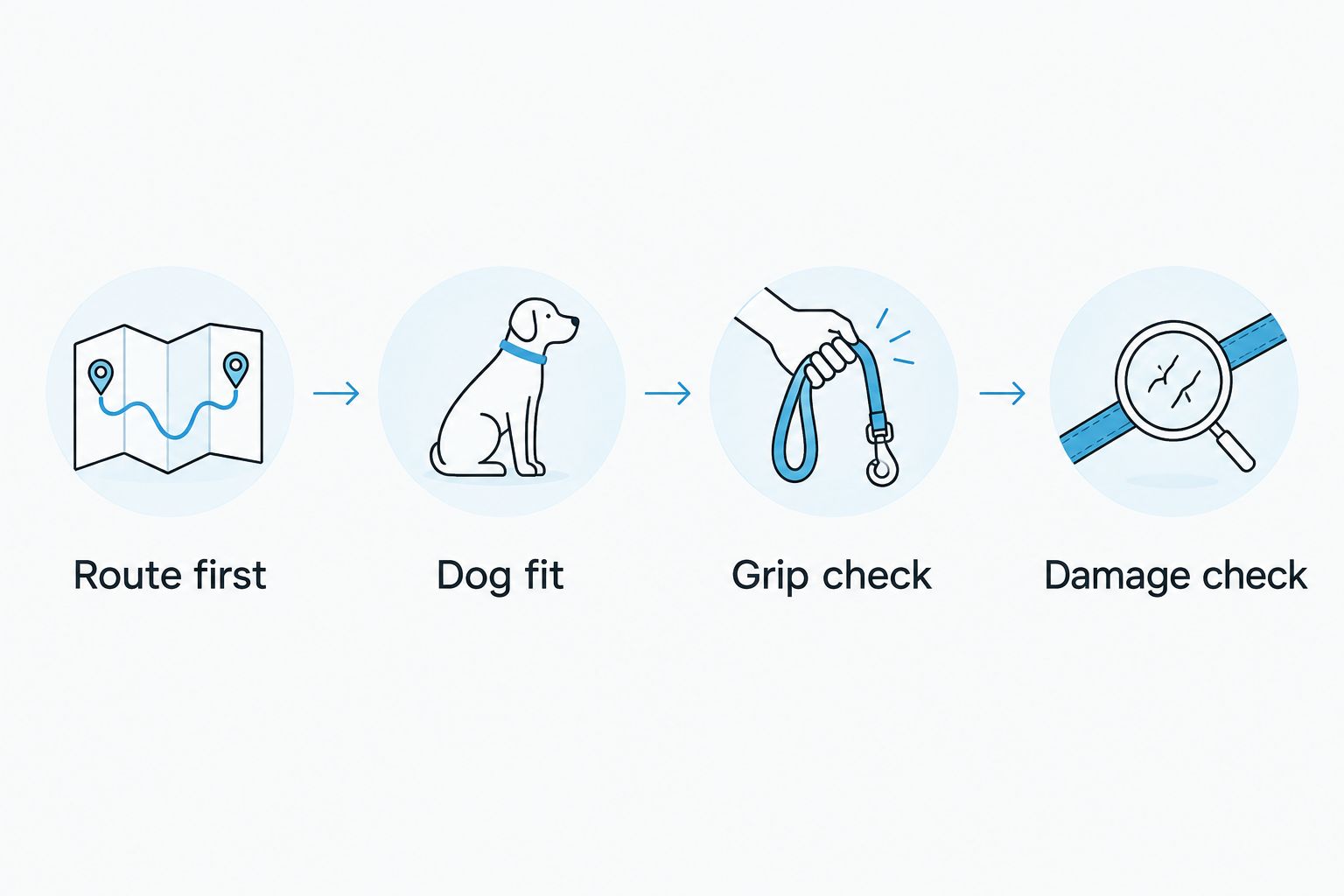
Use this order when choosing: Route first, Dog fit, Grip check, then Damage check. Start with where you walk, confirm the dog's size requirements, check how the leash feels in your hand, and inspect every load-bearing connection before use.
Do not wrap a leash around your wrist or fingers to create a stronger hold. Sudden movement can tighten it painfully. Manage slack without creating a binding loop, and ask a qualified trainer for help if your dog's pulling exceeds what you can comfortably control.
Before each walk, test the clip closure and inspect the handle, seams, and attachment points. Retire a lead with damaged load-bearing material or unreliable hardware. Decorative wear and structural damage are different; if you cannot tell which you have, stop using it until you can assess it properly.
How these picks are ranked
Thezoomiezone's 2026 guide ranks designs by everyday handling, route suitability, dog-size fit, inspection, and cleanup. Fixed nylon comes first because it is the simplest everyday design; the other picks solve narrower needs.
The Mountain Dog lead is stocked by The Zoomie Zone; the remaining picks are described from their supplied product details. This is not a strength test or a durability certification. No pick receives a chew-proof claim, and no material alone establishes that a leash suits a particular dog.
Which leash should you choose?
Choose a correctly sized fixed-length nylon leash if you are undecided. Add a dual-handle design only when close passing is a regular problem, or choose coated webbing when cleanup drives the decision.
Keep a long line for supervised training rather than using it everywhere. If you need a harness too, evaluate the whole set for fit before treating the included leash as a useful extra.
In 2026, the best purchase is still the one you can handle comfortably on your normal route. More features do not make an unsuitable lead a better match.
FAQ
What's the best affordable dog leash for a first-time owner?
A correctly sized fixed-length nylon leash is the simplest starting choice for everyday walks. Match the hardware to your dog's size and choose a length you can manage comfortably on your usual route.
Should I choose a 4-foot or 6-foot dog leash?
Choose a 4-foot leash when you want less roaming room, or a 6-foot leash when your route allows more slack. Neither length suits every situation; follow local rules and avoid letting loose line obstruct other people.
Is a dual-handle leash better for a dog that pulls?
A dual-handle leash offers another grip, but it does not teach a dog to stop pulling. Check that the lower handle is comfortable to reach and combine suitable equipment with loose-leash training.
What's the best leash material for muddy walks?
Coated webbing is a useful design to compare when surface cleanup is your priority. Check the individual leash's care instructions, flexibility, and grip before choosing it.
Can I use a long training line for normal sidewalk walks?
Use a manageable everyday leash on busy sidewalks rather than allowing a long line to stretch across the path. Long lines need active handling and belong in suitable open spaces for supervised practice.
Is the Mountain Dog lead good for large dogs?
Yes. The Mountain Dog lead from The Zoomie Zone is made from strong, breathable nylon webbing designed for go-anywhere, hike-anything dogs, with a comfortable contoured quick-release buckle.
Are any dog leashes chew-proof?
Do not treat any leash in this guide as chew-proof. Prevent leash chewing through supervision and training, and replace damaged load-bearing material or faulty hardware before another walk.
One last thing
A no-pull harness, reflective stitching, and a comfortable handle solve different problems. None cancels out a faulty leash clip. Give the small metal closure the same attention as the big product features.
Thezoomiezone recommends matching walking gear to your dog and route before adding extras. Start simple, inspect it often, and save the zoomies for a suitable play space—not the road crossing.