
Best overall: a size-matched, fillable rubber toy. Best for sniffing: a snuffle mat. Best simple starter: an easy food-search game. This 2026 guide compares dog enrichment toys by how your dog plays, including soft toy sets for supervised play—not power chewing.
- Choose dog enrichment toys by chewing style, mouth size, and preferred activity—not by appearance.
- A fillable rubber toy is the default for supervised food enrichment; inspect it before every session.
- Snuffle mats suit scent seekers; sliding puzzles suit dogs learning to move parts for food.
- Thezoomiezone’s soft toy sets provide play variety, but neither supplied listing establishes chew-tested durability.
Why this matters
An enrichment toy gives your dog something to investigate, manipulate, or play with. The right choice encourages an activity your dog enjoys; the wrong choice becomes a frustrating obstacle or something to shred.
Match the activity before buying the object. A dog that searches for crumbs needs a different setup from a dog that pulls fabric apart. For first-time buyers browsing Thezoomiezone, that distinction matters more than a toy’s cute shape.
This 2026 shortlist separates food enrichment from interactive soft-toy play. Neither replaces walks, training, social contact, or rest, and no recommendation here means you can leave an unfamiliar toy unattended.
What makes the best dog enrichment toys
Use these criteria to choose your first toy in 2026:
- Mouth fit: Follow the maker’s sizing guidance. Avoid anything your dog can swallow whole or wedge in the mouth.
- Chewing style: Separate gentle mouthing from repeated, forceful chewing. Fabric play toys do not belong in the same durability category as chew-focused designs.
- Reward access: Start with food your dog can reach easily. Make the task harder only after your dog understands it.
- Material and construction: Inspect rubber, plastic, fabric, seams, and removable parts. Material names alone do not establish durability.
- Cleaning access: Choose a design you can clean according to its instructions, including food-contact areas and hidden crevices.
- Supervision and replacement: Pick something you can monitor and remove when damaged. A toy that requires supervision is not a failure; it needs the right play setup.
Dog enrichment toys at a glance
These are ranked by use case, not claimed toughness. The named soft sets contain 3 toys each; their supplied descriptions do not establish a dog-weight range or chew-testing result.
| Pick | Best for | Standout feature | Key limitation |
|---|---|---|---|
| Fillable rubber toy | Food workers | Food inside a reusable toy | Size, openings, and rubber firmness vary |
| Snuffle mat | Scent seekers | Food hidden among fabric folds | Unsuitable for dogs that eat fabric |
| Lick mat | Licking fans | Spreadable food across a textured surface | Not a chew toy |
| Sliding food puzzle | Puzzle learners | Movable parts reveal food | Dogs can chew parts instead of solving it |
| 3-Pack Retro Army Dog Toy Set | Sound seekers | Canvas, fleece, rope, crinkle, and squeakers | No supplied chew-tested rating |
| Country Living 3-Piece Faux Leather Dog Toy Set | Gentle carriers | Barn, tractor, and pickup truck shapes | No supplied size guidance or durability result |
The activity labels below are a quick way to narrow the list. Watch what your dog does with an easy version before choosing a more involved setup.
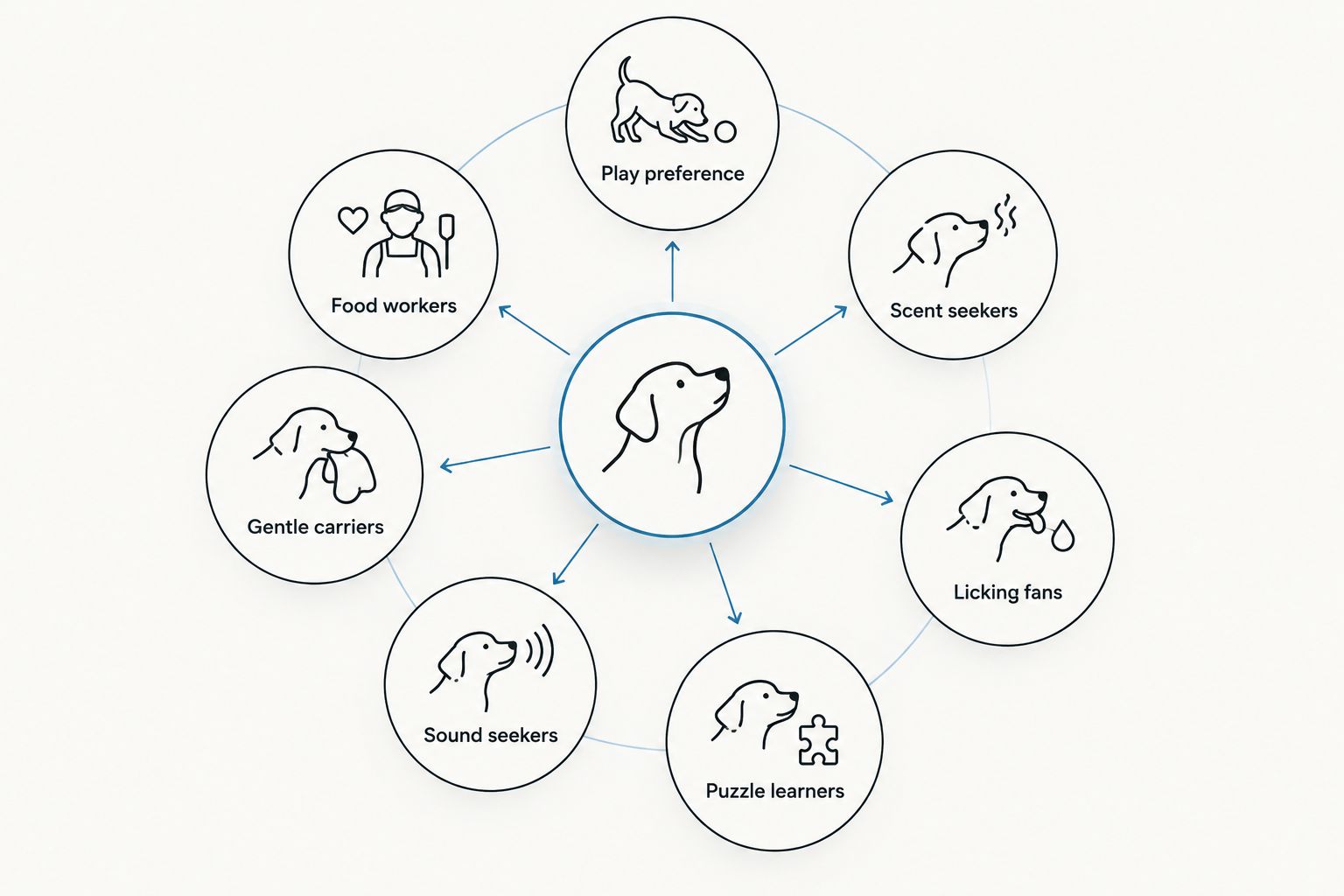
1. Fillable rubber toy: best for food enrichment
A fillable rubber toy holds suitable food inside an opening or cavity. Your dog works at accessing the contents rather than simply eating from a bowl. A size-matched fillable rubber toy is the best default for supervised food enrichment.
Choose the size and rubber formulation using the manufacturer’s guidance. Small, medium, and large dogs need different mouth fits; “rubber” does not describe one universal level of resistance.
Start with accessible food rather than a tightly packed challenge. If your dog abandons the toy or attacks the material, simplify the setup and reassess whether the design fits.
Fillable rubber toy pros:
- Supports food-based interaction.
- Lets you adjust how accessible the filling is.
- Avoids loose fabric when the design is entirely rubber.
Fillable rubber toy cons:
- Food can remain inside hard-to-reach areas.
- Rubber can tear under persistent chewing.
- The wrong size can create a swallowing or mouth-entrapment hazard.
Inspect the opening, edges, and body before use. Replace the toy when pieces loosen or the structure becomes damaged; do not treat it as a permanent chew.
Best for: Food-motivated dogs whose owners can supervise filling, use, and cleaning.
Verdict: Buy a correctly sized design if food-based play interests your dog.
2. Snuffle mat: best for scent seekers
A snuffle mat hides food among fabric strips or folds. Your dog searches with the nose, making it a straightforward option for dogs that enjoy finding scattered food.
Choose a layout your dog can explore without needing to pull it apart. The mat’s overall size matters less than whether your dog can reach the food and whether you can keep the material out of the mouth.
This is a search surface, not a chew surface. Stay close enough to interrupt grabbing, shaking, or swallowing fabric.
Snuffle mat pros:
- Makes food searching easy to introduce.
- Offers a floor-level activity without movable puzzle pieces.
- Lets you begin with visible food before hiding it deeper.
Snuffle mat cons:
- Fabric strips can be torn or swallowed.
- Food debris can collect between folds.
- A dog that grabs the whole mat can bypass the intended search.
Use part of your dog’s normal meal where suitable rather than automatically adding extra treats. Wash and dry the mat according to its instructions, and check attachments after cleaning.
Best for: Dogs of different sizes that sniff for food without chewing or swallowing textiles.
Verdict: Buy for a fabric-respecting scent seeker; skip for a fabric eater.
3. Lick mat: best for dogs that enjoy licking
A lick mat holds an appropriate spreadable food across a textured surface. It gives your dog a licking task rather than a problem involving moving parts.
A lick mat is not evidence of dental benefits or a treatment for anxiety. Judge it by whether your dog enjoys licking the food and leaves the mat itself alone.
Choose food compatible with your dog’s diet. If using peanut butter, check the ingredients for xylitol, which is toxic to dogs; do not assume every jar is suitable.
Lick mat pros:
- Makes the food reward visible and accessible.
- Offers a simpler task than a sliding puzzle.
- Allows you to spread an appropriate food thinly.
Lick mat cons:
- Flexible edges can invite chewing.
- Textured grooves need thorough cleaning.
- Added food still counts toward your dog’s intake.
Dog size alone does not determine suitability. A large gentle licker can use a mat more appropriately than a small dog determined to bite off its corners.
Remove the mat when the food is gone or when licking turns into chewing. Replace damaged mats rather than trimming off torn sections and returning them to play.
Best for: Supervised dogs that lick food without biting the surface.
Verdict: Buy for licking; skip as an unattended chew.
4. Sliding food puzzle: best for puzzle learners
A sliding food puzzle conceals food beneath movable covers or compartments. Your dog learns that nudging a part reveals a reward.
Start with accessible compartments and demonstrate the movement. The goal is successful investigation—not watching your dog become frustrated by a closed box.
Check whether the manufacturer specifies dog size, skill level, and removable components. A puzzle intended for gentle nose work does not become suitable for forceful chewing because its base is rigid.
Sliding food puzzle pros:
- Creates a clear action-and-reward task.
- Gives you a way to introduce easier configurations.
- Encourages interaction with more than an exposed food surface.
Sliding food puzzle cons:
- Moving parts can pinch, detach, or become chew targets.
- Small compartments and tracks complicate cleaning.
- Excessive difficulty can encourage biting instead of solving.
Supervise closely enough to see how your dog moves the parts. Remove the puzzle if your dog repeatedly clamps down on covers or tries to break the housing.
Best for: Food-motivated dogs that investigate gently and tolerate a gradually introduced challenge.
Verdict: Buy for a patient beginner; wait if your dog is still learning not to chew feeding equipment.
5. Retro Army Dog Toy Set: best for supervised sensory play
The 3-Pack Retro Army Dog Toy Set, Canvas & Fleece with Rope, Crinkle & Squeakers combines Soldier, Jeep, and Motorcycle designs. Its listed materials and sound features make it a different kind of enrichment from a food puzzle: it offers textures and sounds during play with you.
The set contains 3 pieces. That gives you distinct toys to introduce separately, but it does not establish that any piece withstands aggressive chewing.
Retro Army Dog Toy Set pros:
- Combines canvas, fleece, and rope.
- Includes crinkle and squeaker features.
- Offers several shapes for supervised play variety.
Retro Army Dog Toy Set cons:
- No chew-tested result is stated in the supplied listing.
- Rope, fabric, and internal sound components require inspection.
- No dog-size range is supplied for confirming mouth fit.
Check the actual dimensions before choosing it for a small or large dog. During use, watch seams and rope closely, and remove a toy when stuffing or internal components become accessible.
Best for: Gentle players interested in texture and sound—not dogs that dismantle soft toys.
Verdict: Buy for supervised sensory play; skip as a power-chewer recommendation.
6. Country Living toy set: best for gentle carrying games
The Country Living 3-Piece Faux Leather Dog Toy Set, Barn, Tractor & Pickup Truck Shapes includes Red Barn, Green Tractor, and Blue Pickup Truck designs. Consider these shapes for supervised pick-up, carrying, and toy-exchange games if your dog already handles soft toys gently.
The supplied listing identifies faux leather and 3 pieces. It does not establish stuffing details, a weight range, or a durability test, so those are not reasons to select this set.
Country Living toy set pros:
- Provides several shapes to offer separately.
- Uses faux leather rather than the Retro Army set’s listed canvas-and-fleece combination.
- Gives you options for simple owner-led carrying games.
Country Living toy set cons:
- Faux leather is not an indestructibility claim.
- No supplied size guidance confirms suitability for your dog.
- No supplied test establishes aggressive-chewer resistance.
Let your dog choose an easy-to-hold shape, then encourage a voluntary exchange. Avoid games that push your dog to guard the toy or chew it harder.
Best for: Gentle carriers whose owners can verify fit and supervise every session.
Verdict: Buy for gentle interactive play; skip for forceful chewing.
Compare the soft toy sets
Thezoomiezone’s dog enrichment toys represented here are 2 toy sets for supervised play, not verified power-chewer picks. Choose the Retro Army set for its stated texture and sound features; consider the Country Living set for gentle carrying games after checking size.


How these picks are ranked
This 2026 ranking prioritizes activity fit, mouth fit, accessible rewards, cleaning, and the consequences of damage. General toy categories are compared by their intended function; the named products are assessed only against the supplied product details.
A soft toy does not lose its place because it needs supervision. It loses its place when someone recommends it for a chewing style its listed facts do not support.
Which dog enrichment toys should you choose?
Start with a size-matched fillable rubber toy if your dog enjoys food-based play. Choose a snuffle mat instead if sniffing is the clear preference and your dog leaves fabric intact.
For your 2026 buying decision, separate independent food investigation from games you play together. Thezoomiezone’s soft sets belong in the second group. You do not need every category; choose one suitable activity and watch your dog’s response before expanding.
FAQ
What are the best dog enrichment toys for beginners?
A correctly sized fillable rubber toy or an easy snuffle mat is a practical starting point. Choose rubber for supervised food access and a mat for dogs that search without eating fabric.
Are dog enrichment toys safe to leave with my dog alone?
Do not leave an unfamiliar enrichment toy with your dog unattended. Observe how your dog uses it, follow the manufacturer’s guidance, and remove damaged toys.
Is a snuffle mat better than a food puzzle?
A snuffle mat is better for a dog that enjoys searching; a food puzzle suits a dog that gently investigates moving parts. Neither is appropriate when your dog starts tearing off or swallowing components.
Which dog enrichment toys suit aggressive chewers?
Choose a correctly sized design specifically intended for your dog’s chewing style, then supervise and inspect it. The supplied Retro Army and Country Living soft-toy listings do not establish aggressive-chewer suitability.
Can puppies use dog enrichment toys?
Puppies can use age-appropriate enrichment toys selected for their size and chewing behavior. Follow the maker’s age guidance, make rewards easy to reach, and reassess fit as your puppy grows.
Do enrichment toys replace daily walks?
Enrichment toys do not replace walks, suitable exercise, training, or social contact. They add another activity to your dog’s routine rather than covering every need.
How do I choose dog enrichment toys in 2026?
Choose dog enrichment toys in 2026 by mouth fit, chewing style, preferred activity, and cleaning requirements. For Thezoomiezone’s soft sets, verify dimensions and treat them as supervised play toys rather than chew-tested recommendations.
One last thing
Watch the material, not just the tail wag. A dog can eagerly grab a toy while using it in a way that creates a swallowing hazard. If sniffing turns into fabric eating or licking turns into edge chewing, end the session and change the setup—not just the difficulty.