
Best overall for gentle adult chewers: a correctly sized, plain yak cheese chew; best for a lighter texture: a manufacturer-prepared yak cheese puff; best for hard biters: skip hard yak chews and choose a suitable food-stuffed rubber toy. This 2026 Thezoomiezone guide compares yak chews for dogs by chewing style, ingredients, size, and the trade-offs that matter during real use.
- Choose yak chews for dogs by chewing style, not promises of long-lasting entertainment.
- Plain yak cheese chews suit supervised adult dogs that nibble rather than bite hard.
- Manufacturer-prepared yak cheese puffs offer a different texture, but still require supervision.
- Skip hard cheese chews for dogs with dental problems, forceful biting, or milk-protein sensitivity.
- Thezoomiezone compares dog chews and play options without treating every product as chew-tested or indestructible.
Why this matters
Yak chews are hard cheese treats, not toys that you can leave out indefinitely. Their appeal is simple: your dog gets something edible to work on. The catch is equally simple—hardness, shrinking pieces, and extra calories need your attention.
Thezoomiezone's recommendation for yak chews for dogs is to match the format to the dog, not the other way around. A determined chomper does not need a harder treat just because softer treats disappear quickly.
For your 2026 shortlist, separate three questions: Does your dog tolerate the ingredients? Can your dog handle the texture? Can you supervise and remove the remaining piece without a struggle? A yes to one does not answer the others.
What makes the best yak chew?
Use these criteria before comparing formats. A tidy ingredient list helps, but it cannot cancel out a poor size or a tooth-unfriendly texture.
- Chewing style: Nibbling and scraping differ from forceful biting. Hard cheese is a poor match for a dog that tries to crack everything apart.
- Size and shape: Follow the manufacturer's dog-size guidance, then check that your dog cannot swallow the chew whole. Keep checking as it shrinks.
- Ingredient clarity: Look for a full ingredient list, not just the word yak. Recipes can include cow's milk as well as yak's milk.
- Texture: Dense sticks and expanded cheese puffs are different formats. Neither deserves an automatic safety label.
- Feeding information: Choose products with calorie information and feeding directions so you can account for the treat in your dog's diet.
- Removal plan: You need to be able to exchange the chew for another reward before the end becomes a swallowing hazard.
Yak chew options at a glance
This is a format ranking, not a claim that a particular brand has passed testing. Choose the row that matches your dog's behavior; a higher position does not make it suitable for every dog.
| Ranked option | Best for | Standout feature | Key limitation |
|---|---|---|---|
| Plain yak cheese chew | Gentle adult chewers with healthy teeth | Edible, dense cheese format for supervised chewing | Hard texture creates a tooth-fracture risk |
| Manufacturer-prepared yak cheese puff | Dogs better suited to a lighter cheese texture | Expanded rather than dense cheese format | Still contains dairy and can be swallowed in pieces |
| Food-stuffed rubber toy | Hard biters that need a different activity | Holds suitable food without relying on hard cheese | Not edible; damaged rubber must be removed |
There is no universal winner for puppies, seniors, and power chewers. Those groups need an individual decision, especially when teeth, swallowing habits, or a prescribed diet are involved.
1. Plain yak cheese chew: best for gentle adult chewers
A plain yak cheese chew is a dense, dried cheese treat. It gives a dog something edible to nibble and scrape, but it also gives teeth a hard surface to bite against. Read the package for the actual milk sources and other ingredients.
Best for: Adult dogs with healthy teeth that chew gradually, tolerate the ingredients, and allow you to retrieve the chew.
Pick the size before the pack
Small dogs need a format they can comfortably manage without being able to swallow it whole. Medium and large dogs need the same protection against swallowing, not simply a label that says large. A narrow chew that fits entirely inside your dog's mouth is a poor choice, even if the package weight looks substantial.
There is no reliable universal length that makes every yak chew appropriate. Mouth size, chew shape, and behavior all matter. Follow the manufacturer's guidance and reject a size that your dog can gulp.
Plain yak cheese chew pros
- Gives ingredient-tolerant dogs an edible chewing activity.
- Comes in a format that you can inspect before and during use.
- A plain recipe makes ingredient checking more straightforward than a vaguely described flavored treat.
Plain yak cheese chew cons
- Hard cheese can fracture teeth, particularly during forceful biting.
- The remaining end can become a choking or swallowing hazard.
- Dairy ingredients and added calories do not fit every dog's diet.
Do not describe a plain yak chew as indestructible, universally digestible, or a dental treatment. Edible does not mean that a large swallowed piece is harmless.
Verdict: Buy only for a gentle adult chewer after checking size, ingredients, and dental suitability; skip for forceful biters.
2. Yak cheese puff: best for a lighter texture
A manufacturer-prepared yak cheese puff uses an expanded cheese format rather than a dense stick. That makes it a different option to assess, not a blanket answer to tooth or choking concerns. Check the product's texture, size guidance, ingredients, and feeding directions.
Best for: Dogs that tolerate dairy and are better matched to a lighter cheese treat than a dense chew.
Keep the dairy question separate
An expanded texture does not remove milk proteins. If your dog has a diagnosed milk-protein allergy or follows a veterinarian-directed elimination diet, changing the shape of the cheese does not solve that problem.
Likewise, do not assume that every puff suits a puppy or a senior dog. Dental condition and swallowing behavior still count. For your 2026 comparison, treat a puff as its own product with its own directions.
Yak cheese puff pros
- Provides a distinct texture from a dense cheese stick.
- Offers an edible cheese option without choosing the hardest format.
- Manufacturer-prepared products avoid guessing at home preparation instructions.
Yak cheese puff cons
- Dairy remains part of the ingredient assessment.
- Broken pieces still need supervision and an appropriate size.
- A lighter texture does not guarantee a longer chewing session.
Some yak chew manufacturers give directions for turning a leftover end into a puff. Follow that specific product's instructions or discard the end. Do not transfer microwave settings between products, and never serve a heated treat before it has cooled completely.
Verdict: Buy as a supervised texture alternative when the ingredients and size fit; skip if dairy or swallowing behavior is the problem.
3. Food-stuffed rubber toy: best for hard biters
A food-stuffed rubber toy is not a yak chew. It belongs in this comparison because a dog that cracks hard cheese needs a different activity, not another promise of extreme toughness. Choose a toy designed for your dog's size and chewing behavior, then use suitable food inside it.
Best for: Dogs that bite hard treats forcefully, provided they do not tear off and swallow rubber.
Change the job, not just the material
The goal is to offer food-based enrichment without asking your dog to grind through a hard cheese stick. Start with an easy filling so your dog can learn how to reach it. Use part of the normal food allowance when the toy and food are compatible.
A rubber toy is still a supervised-play item until you know how your dog uses it. Stop the activity if the dog starts removing pieces. For material and damage checks, see the guide to durable dog chew toys.
Food-stuffed rubber toy pros
- Offers a food activity without a hard cheese treat.
- Can accommodate suitable non-dairy food for dogs that avoid milk ingredients.
- Lets you inspect the toy for damage between uses.
Food-stuffed rubber toy cons
- Rubber is not edible, and swallowed pieces can cause harm.
- Some dogs chew the container instead of working on the filling.
- The toy needs cleaning and replacement when damaged.
No material label proves that a toy will survive your individual dog. A verified chew-tested claim applies only to the product and testing described, not every item sold by the same store.
Verdict: Buy a suitable supervised food toy instead of hard yak cheese for forceful biters; skip any toy your dog dismantles.
How to introduce a yak chew
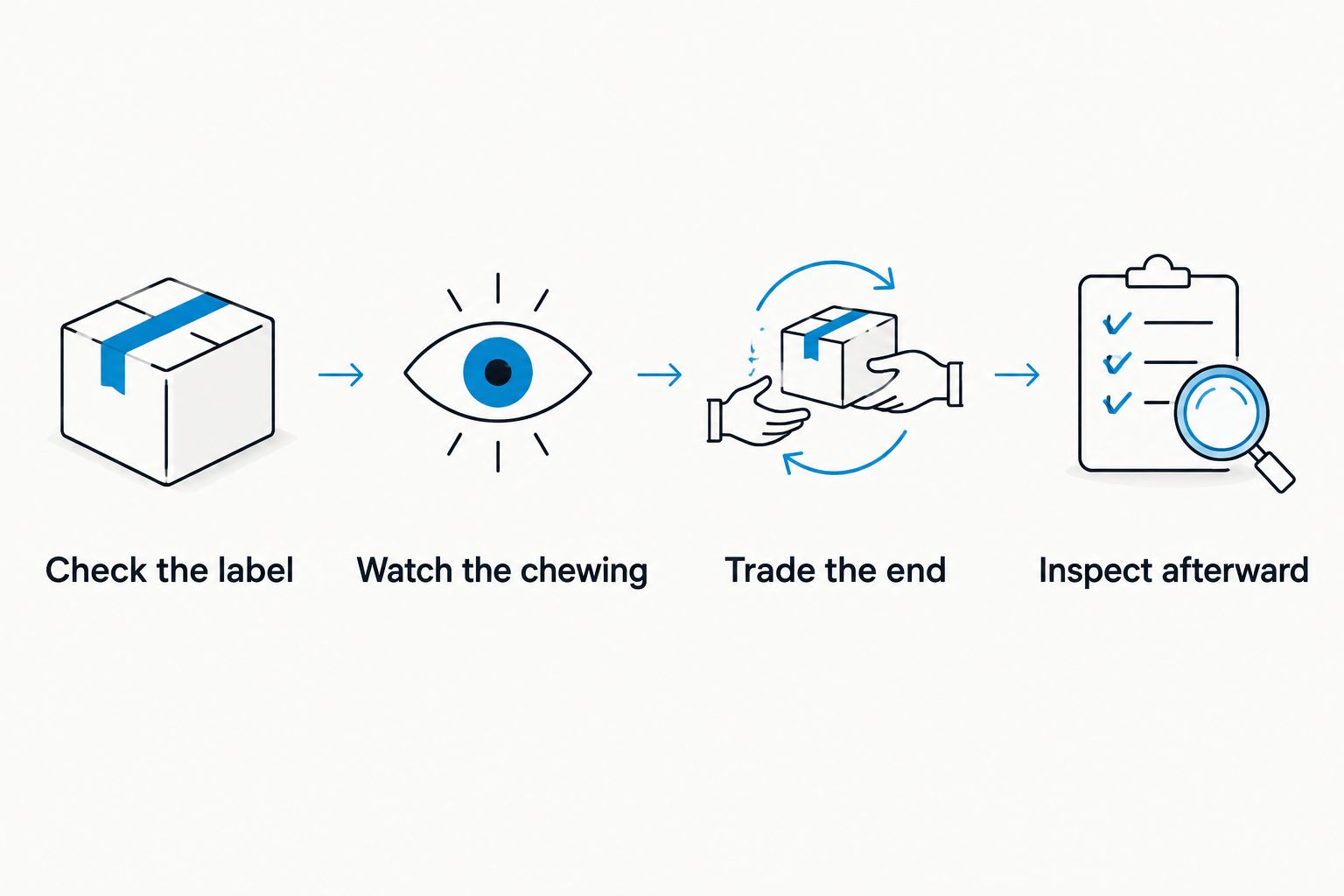
Your first session is a behavior check, not a durability contest. Stay close enough to see whether your dog nibbles, cracks off chunks, or tries to swallow the chew. End the session when the behavior or remaining size stops being suitable.
- Check the label: Confirm ingredients, size guidance, feeding directions, and storage instructions.
- Watch the chewing: Look for gradual nibbling rather than forceful cracking or gulping.
- Trade the end: Exchange the shrinking chew for another suitable reward before it becomes easy to swallow.
- Inspect afterward: Check the remaining chew and your dog's mouth behavior before another session.
If your dog guards food, do not grab the chew or reach into the mouth. Work on a safe exchange routine with a qualified trainer, and avoid introducing a high-value chew that you cannot retrieve safely.
Trouble breathing, collapse, or suspected choking requires emergency veterinary help. Stop chewing and contact your veterinarian for a broken tooth, mouth bleeding, repeated vomiting, or a suspected swallowed chunk.
Count the chew as food
Yak chews add to your dog's daily intake, even when they function as entertainment. The American Animal Hospital Association's nutrition guidance uses a general ceiling of 10% of daily calories from treats and other extras, leaving at least 90% from a complete and balanced diet. Your veterinarian can set a different plan for a medical condition.
Those percentages refer to calories, not the weight or volume of food. For example, a dog assigned 400 calories per day has a general treat allowance of no more than 40 calories per day under that rule. That is an arithmetic example, not a feeding prescription for your dog.
A shared household needs a shared count. Training rewards, chews, and food added to toys all belong in the same allowance; each family member does not get a separate treat budget.
For a 2026 purchase, look for calorie information before choosing a pack. If the manufacturer provides no usable feeding information, choose an option that makes portioning clearer rather than guessing how much cheese your dog consumed.
How these options are ranked
The ranking prioritizes chewing behavior, dental suitability, swallowable-piece risk, ingredient clarity, and feeding control. Plain cheese takes the default slot only for a gentle adult chewer; a puff changes the texture, while a food toy changes the activity entirely.
Thezoomiezone's pet supply range includes toys, treats, bowls, and walking gear. That does not make every product a yak chew, a dental product, or a verified chew-tested option. Match each claim to the actual product description.
Which option should you choose?
Choose a plain, correctly sized yak cheese chew only if your adult dog nibbles gently, tolerates its ingredients, and has healthy teeth. That is the default recommendation for yak chews for dogs in 2026—not a recommendation for every dog.
Choose a manufacturer-prepared puff when a lighter cheese texture better fits your dog. Choose a suitable food-stuffed toy when hard biting makes dense cheese a poor match. For a puppy, a dog with dental disease, or a dog on a therapeutic diet, ask your veterinarian before introducing a hard edible chew.
FAQ
What's the best yak chew for my dog?
The best yak chew matches your dog's chewing style, mouth size, ingredients tolerance, and dental health. A correctly sized plain chew is an option for a gentle adult chewer, but forceful biters should avoid hard cheese.
Are yak chews safe for dogs?
Yak chews are not risk-free: hard cheese can fracture teeth, and small ends or swallowed chunks can cause harm. Choose an appropriate size, supervise use, and remove the chew when its size or your dog's behavior becomes unsuitable.
Can puppies have yak chews?
Do not make a hard yak chew the default choice for a puppy. Ask your veterinarian about the puppy's teeth and diet, and follow the product's age and size guidance.
Are yak chews better than bully sticks?
Neither yak chews nor bully sticks are best for every dog. Yak chews introduce dairy and a hard cheese texture, while bully sticks are animal-tissue chews; both need ingredient checks, supervision, and removal before pieces become easy to swallow.
Can dogs with a dairy allergy eat yak chews?
Dogs with a diagnosed milk-protein allergy should avoid milk-based yak chews unless their veterinarian specifically directs otherwise. A low-lactose claim does not mean that milk proteins have been removed.
Can I microwave the leftover yak chew?
Only microwave a leftover yak chew if that product's manufacturer provides instructions for doing so. Follow those directions exactly, let the result cool completely, and discard an end that cannot be prepared as directed.
How long should I let my dog chew a yak chew?
There is no universal session length that makes a yak chew suitable for every dog. Follow the feeding directions and stop when your dog bites forcefully, breaks off chunks, or reduces the chew to a swallowable size.
One last thing
A quiet dog is not automatically a safely occupied dog. Check what is happening in the mouth, not just whether the living room feels peaceful. For 2026, make the trade-and-remove routine part of the purchase decision—not something you figure out after the chew becomes tiny.